CITYPASS
Cart
Astana
Astana
Almaty
Almaty
ChinaPass
ChinaPass


youtubeinstagramfacebook

Attractions list

Access to more than 34 attractions in Astana
Excursion by the double decker bus (Red Bus)
#Excursions
Available today
free with CityPass

Excursion by the double decker bus (Red Bus)

Baiterek Monument Square
Show on map

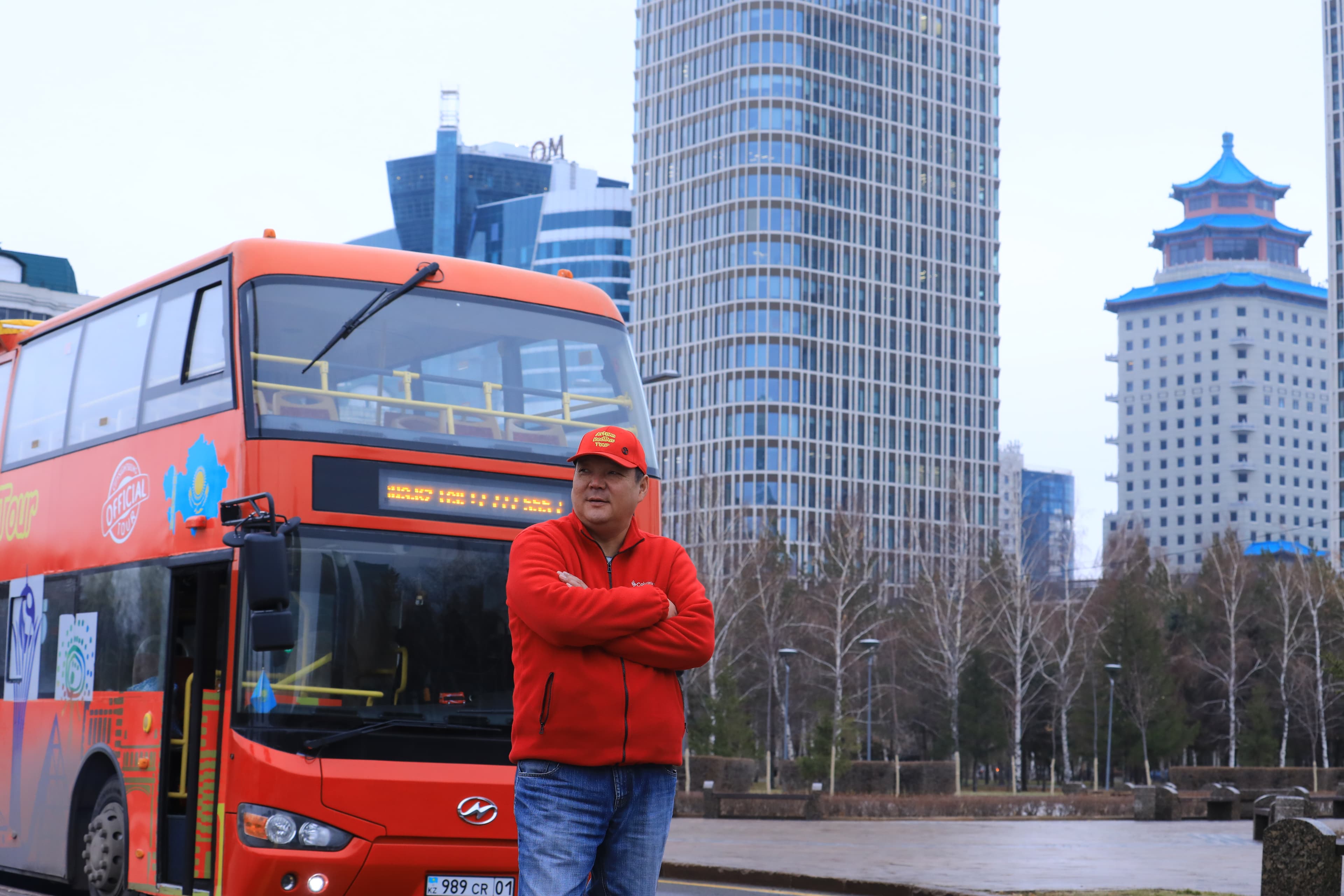
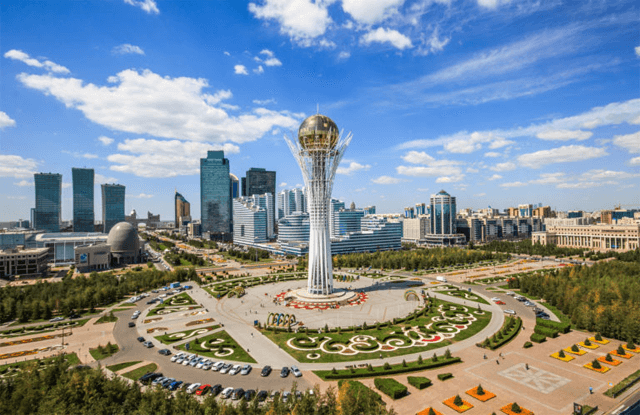
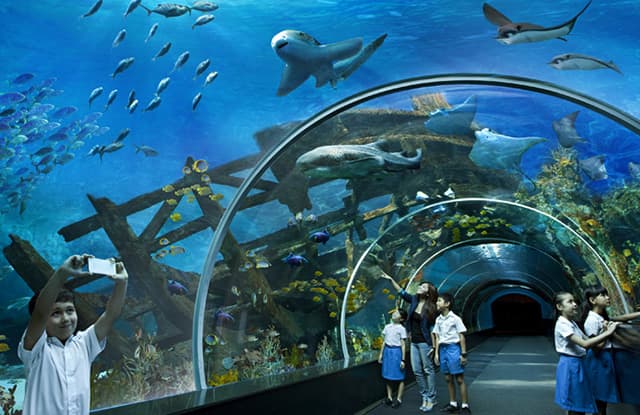
Astana city tours on Red Bus double-decker buses. The sightseeing tour goes through the very heart of the city. The main sights of the capital will fly past you. You will immerse yourself in the history of almost every building, feel the atmosphere of the left bank, and get unforgettable impressions!How to get to the departure point?You can board the bus at any stop on our route. During the tour, we make 7 stops:📍 Astana-Baiterek Monument: Enjoy a panoramic view of the entire city from a bird's eye view, feel its beauty and scale.📍 Ailand Family Recreation Center: Oceanarium, jungle, Ferris wheel and other entertainment attractions for the whole family.📍 Boat station on the Embankment (Zheltoksan 2/2): Feel the wind of freedom on the water, enjoying the beautiful views of the Embankment and the surrounding landscape.📍 Khan Shatyr Shopping Mall: Take a look at the world of shopping and entertainment, immerse yourself in the atmosphere of modern trade and leisure.📍 Triumphal Arch: Feel the grandeur and significance of this historical symbol of the city, enjoying its majestic view.📍 Nur-Alem Museum of the Future (Expo): Discover the amazing world of science, technology and innovation presented in this futuristic museum.See our schedule on the website https://redbus.kz/ru/marshruty/ and choose a convenient time and place for you. If you have any additional questions, do not hesitate to call our call center (+7 777-555-75-75). Get ready for an exciting journey! 🚌🌟

Excursion to the "Astana Opera" House
#Excursions
Available today
free with CityPass

Excursion to the "Astana Opera" House

Kunaeva 1
Show on map

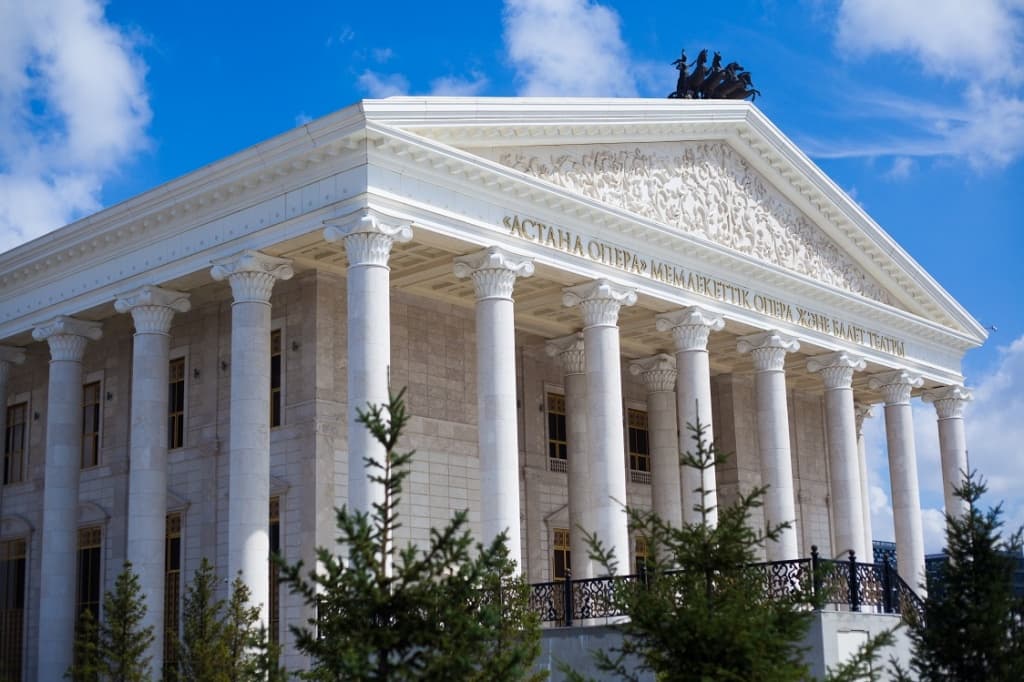
“ASTANA OPERA”is the largest temple of art in Central Asia. It is the only classical theatre of this scale erected in the last few decades throughout the Eurasian region. This is one of the most technically advanced theatres in the world... The magnificent building of «Astana Opera» has already been inscribed in the history of our country. The State Theatre of Opera and Ballet «Astana Opera» was founded in 2013 on the initiative of the First President of the Republic of Kazakhstan. Overall, the project is designed in the classical style, with an emphasis on the Hellenistic motifs, Mannerism and Baroque. In this case, turning the hands on the architectural clock several centuries ahead from the Ancient Greek style was not only fitting, but also avery important decision. In front of the main entrance a tremendous footbridge thatblends harmoniously with the grand project called “Astana Opera” was elevated. The theatre is situated on a plot of almost 9 acres. The building itself is 64,000 square meters. Of these, about 3,000 square meters is the stage area, which includes 4 stages. Astana OperaHouse is impressive not only in its scale, but also its architectural refinement.At the main entrance to the theatre the portico is decorated with designer sculptural compositions “Kobyz Player” and “Girl with Zhetygen”, authored by sculptors M. A. Mansurov and T. T. Yermekov.The waves of feather grass serve as a pedestal to the seated figures – they seem to raisethe figures over the steppe, elevating and poeticizing the image of musicians. The stately figure of the young man, his face with the profound look of the steppe creator, tied with a beautiful knot headband, details of his clothing and kobyz - Kazakh folk instrument on which he plays - everything is carefully thought out and aligned.The second figure is a girl playing a musical instrument «zhetygen» Beautiful wistfulface with her eyelashes lowered, high headdress covered with a shawl, her clothes – eachdetail is molded with ethnographic accuracy and thoroughly elaborated. The very contour ofthe figures fits perfectly into the theatre facade niches and corresponds exactly to the wall height to the portico.Perhaps every theater guest, plunging into the inner atmosphere, will feel and receive an unforgettable experience that will make them want to visit the theater again.

Berik Alibai's House-Museum
#Museum
Available today
free with CityPass

Berik Alibai's House-Museum

54 Kordai Street
Show on map

Berik Alibai Satinbekovich is a famous Kazakhstani jeweler, restorer and teacher who has made a significant contribution to the development and preservation of the national jewelry art of Kazakhstan. Born in 1964 in the village of Kyzyl-Sai, Merken district, Zhambyl region. He graduated from the N. Gogol Almaty Art College and the T. Zhurgenov Kazakh National Academy of Arts. Since 1989, he has been an active participant in national and international exhibitions, presenting his work in countries such as China, Saudi Arabia, Japan, Iran, Russia, Qatar, Turkey, Germany, Spain, the Sultanate of Oman and England. His works, including women's jewelry, weapons, saddles and hats, are known for their unique style, combining traditional Kazakh motifs and modern design solutions.Berik Alibai is a member of the Union of Designers and the Union of Artists of Kazakhstan. In 2009, he was awarded the title of "Kazakstannyn enbek sirgen kayratkeri" (Honored Worker of Kazakhstan), and in 2013 he was awarded the Diamond Order of Carl Faberge for his contribution to the development of world cultural heritage.In addition to his creative work, Alibai was engaged in restoration, heading the department of restoration of metal, wood, leather and bone products at the Center for Conservation and Restoration of the National Museum of Kazakhstan. In 2024, he presented a book dedicated to jewelry, in which he spoke about his creative path and experience.Berik Alibai's works are kept in the collections of the National Museum of the Republic of Kazakhstan, the Central State Museum in Almaty, as well as in private collections of art connoisseurs and collectors from various countries.

Museum of Art
#Museum
Available today
free with CityPass

Museum of Art

Astana, Otyrar st., 1/2
Show on map

The museum displays over 1,600 national musical instruments. Rare and long-forgotten ancient instruments such as the zhelbuaz, mes syrnay, uildek, tastayyk, and many others occupy a special place among them. All of these instruments were created by museum staff.The museum will also house a scientific laboratory workshop named after Bolat Sarybayev. This center, equipped with modern equipment, will study, modernize, and present national musical instruments to the public on a scientific basis.A unique collection of national clothing and headdresses will also be on display.The multi-sport ensemble JOSHY QAZAQ NATIONAL GROUP, comprised of museum staff, will perform during large-scale cultural events.It's worth noting that the museum is housed in an old schoolhouse built in the late 19th century. Since 1982, the building has been included in the list of historical and cultural monuments of national significance and has been under state protection.

«Lumiere-Hall» Multimedia Museum. Exhibition «Van Gogh. Living Canvases»
#Museum
Available today
free with CityPass

«Lumiere-Hall» Multimedia Museum. Exhibition «Van Gogh. Living Canvases»

Abay Avenue, 8, 3rd floor
Show on map

The Lumiere-Hall multimedia museum opens in Astana with the multimedia exhibition "Van Gogh. Living Paintings," arriving from the Netherlands, the birthplace of Vincent van Gogh.Immersion in the World of Van GoghThis large-scale multimedia show will allow visitors to experience the works of the great master. Innovative technologies will transport viewers through time, letters, and paintings into Van Gogh's wondrous world. You will gain a deeper understanding of who he was—a great master, a mad genius, or an unfortunate artist doomed to eternal solitary wandering.What awaits you at the exhibition?Visitors will not only be able to get a closer look at the works of art but also learn more about the artist's life and the story behind his most famous paintings. The multimedia format will allow you to find yourself at the very center of the events depicted on the canvases, capture the artist's mood, and even see famous landscapes and portraits in a new light.

«Astana-Baiterek» Monument
#Monument#Family
Available today
free with CityPass1500.00 without CityPass

«Astana-Baiterek» Monument

Nurzhol Boulevar, 14
Show on map

Baiterek monument is one of the most recognizable monuments of the capital of Kazakhstan. The idea of erecting the monument belongs to the First President of the Republic of Kazakhstan – Nursultan Nazarbayev. The idea of building the monument arose from N. Nazarbayev on Board the presidential plane, during the flight. The plan of the futuristic structure was depicted on a paper napkin. The monument itself contains a deep philosophical meaning that interprets the views of ancient nomads.The Ishim river (the left tributary of the Irtysh) represents the World river, on the Bank of which" grows "the Tree of Life — "Baiterek". According To N. Nazarbayev, "everyone who rises to the top of Baiterek will absorb the steppe expanse of Kazakhstan". In the center of the hall is a wooden globe with autographs left by representatives of 17 religions. Next to it is the composition "Ayala alakan" with the impression of the President's right hand.Visitors to the monument believe that if you make a wish, while putting your hand in the print, it will certainly come true.Baiterek is a symbol of independent Kazakhstan, the main attraction of our capital. In this regard, the flow of people wishing to visit Baiterek does not decrease, and queues arise. With a smart card Astana PASS You pass the queue at the checkout, but unfortunately have to wait in the queue.The construction took place under the supervision of domestic architects B. Islamov and A. Rustembekov. Gathering a talented team of designers, engineers and designers, they erected a magnificent structure that became not only a symbol of the capital, but also of the entire country. The construction of the Baiterek monument took 6 years and lasted from 1996 to 2002.Immediately after the opening, the monument "Astana-Baiterek" was awarded the prestigious Grand Prix award in a competition organized by the international Association of the Union of Architects (MASA) of the CIS countries.Inside, the monument is divided into three zones, which corresponds to the idea of the Tree of Life, which represents the Universe. On the first, so-called underground level, there are aquariums, cafes and an exhibition gallery, which presents art objects of talented Kazakh artists.The second level, called the ground level, is a tower, inside which the high-speed elevators move. The third level is called the sky, this is the glass ball itself, which offers tourists a panoramic view of the beauty of the young capital.The monument "Astana-Baiterek" is not only an architectural monument or a high-class engineering structure, it is the embodiment of the ideology of the entire state, which is proud of its past, frozen in the roots of the Tree, values its present, which has become a solid support for the future, to which our country is taking a firm and confident step.The Baiterek monument is one of the main attractions of the capital that every tourist should visit, so every day many tourists climb to the top of the monument, sometimes creating queues to buy tickets at the ticket office. On average, about 500 thousand tourists visit Baiterek every year.In 2017, major repairs and reconstruction of Baiterek were carried out, a lot of work was done to finish the interior. After the restoration, the price of a ticket to Baiterek changed. For adults, the ticket price to the Monument is 700 tenge, the price for children is 300 tenge.The monument created everything for a comfortable stay, along with an amazing atmosphere and magnificent views of the capital, for guests there are cozy cafes and bars, a shop with Souvenirs, polite staff who are always ready to help you.

Museum of Saken Seifullin
#Museum
Available today
free with CityPass

Museum of Saken Seifullin

Auezova St., 20
Show on map

The Seifullin Museum in Astana was opened in 1988, in a building belonging to the number of architectural monuments of the last century. The Museum building was built in 1946.The Seifullin Museum consists of six halls filled with the history of various periods of the poet's life. All expositions make it possible to preserve the memory of the creative work of the writer, his role in the development of culture and the formation of the poet as a person.Saken Seifullin's life and social activities are characterized by more than 5,000 exhibits. Personal belongings of the poet, books and photos presented in the Museum's collection can tell a lot about the poet Saken Seifullin, and the fruitful life of Akmolinskaya 20-30 years. XX century. Among the Museum's exhibits, visitors can see photos of Nina Mokina-the poet's Muse, a portrait of her mother, favorite books, manuscripts, and just feel closer to the writer, because the walls still remember him.For a more detailed and thorough acquaintance with the work of Saken Seifulinn, the Museum has a service for providing excursion support for tourist groups. The Museum also regularly hosts open classes and various seminars for schoolchildren and students

Water walks along the river Ishim
#Excursions
Available today
free with CityPass

Water walks along the river Ishim

on the embankment in front of the Palace of Schoolchildren
Show on map

Boat trips on the Ishim river were launched in 2008 and every year the opening ceremony is expected by both adults and children.This is a very good place for declarations of love – and not only to your partner, but also to your mother, your Homeland, and all of humanity.Nearby is the Central Park, where you can ride rides with children, arrange a bike ride or just relax in the fresh air.Thanks to CityPASS, you can visit an unforgettable tour of Astana with a walk on the river tram along the Ishim river. You will get acquainted with the main sights of the capital and enjoy a panoramic view of the city from the Ishim river. During a river walk, the boat offers excellent views of the capital's embankment. The walking route is 18.8 kilometers, which lasts about 45 minutes and passes through the most picturesque places of the city - from the automobile bridge on Sary-ARKA Avenue to the bridge near the Ramstor hypermarket. The passenger route has 6 stops: Central Park, Chubary district, Vremena goda square, Samal district, Kenesary monument and the Radisson hotel.

National Museum of the Republic of Kazakhstan
#Museum
Available today
free with CityPass

National Museum of the Republic of Kazakhstan

auelsizdik pr, 54.
Show on map

The national Museum of the Republic of Kazakhstan in Astana is the largest and youngest Museum in Central Asia. The Museum was created on behalf of the First President of Kazakhstan, Nursultan Nazarbayev, as part of the state program "Cultural heritage".The building of the national Museum of Kazakhstan is located on Independence square – the main square of the country, harmoniously combining in a common architectural ensemble with such important objects as the monument "Kazakh Eli", The Palace of Independence, the Palace of peace and harmony, the national University of arts and the mosque "Hazret Sultan".The national Museum of Kazakhstan has a unique Fund of many values identified in the framework of the "Cultural heritage" program. All the exhibits are located on a huge territory – 11 exhibition halls with a total area of more than 14,000 sq. m. the Museum Building is another attraction of the city – unusual shapes and stunning architectural solutions attract the eyes of thousands of tourists. The unique Museum complex with a total area of more than 74,000 square meters, consists of seven blocks with variable number of storeys to 9 storeys.The national Museum of Kazakhstan consists of the following halls: Astana Hall, hall of Independent Kazakhstan, Halls of gold, Hall of ancient and medieval history, Hall of history, hall of Ethnography, Halls of modern art. The structure of the Museum was developed by a research Institute and is ideal for studying the national heritage of the Republic. The Museum also provides separate rooms for a children's Museum, a center for children's creativity, two exhibition halls, restoration workshops, laboratories, professional storage facilities, a scientific library with a reading room, a conference room, and souvenir kiosks.The first thing you do when you enter the national Museum of the Republic of Kazakhstan is a Golden eagle hovering near the ceiling. The eagle is a symbol of freedom, loyalty and courage. It is better to start the tour with the Astana hall, which not only displays awards, cups, gifts, a lot of photos of the President and guests of the capital, but also every hour there is a show "dynamic layout of the Central part of modern Astana". Before Your eyes, the city of Astana will grow from a flat floor in cubes in chronological order of construction of attractions and residential complexes of the city. After the show, the layout still stands for some time, it is so interesting that you must see it with your own eyes.The Museum in Astana impresses with its technical equipment that meets international standards. For expositions are used: a unique curved screen with special content that works for two halls, a media floor, a dynamic layout of the Central part of modern Astana, numerous media screens, holograms, led technology, touch kiosks, a multimedia guide with information in three languages and other modern exhibition technologies.The national Museum of Kazakhstan is a venue for various excursions for residents and guests of the capital – these are thematic and sightseeing, specialized, philosophical, excursions built in a game form and interactive classes.The main goal of the national Museum of Kazakhstan is to become a cradle of modern culture, a place for intellectual reflection, analysis, comparison, reasoning, statements and evaluation of the historical and cultural heritage of Kazakhstan. Here you can find the main features of a modern Museum – an open dialogue with visitors. This Museum has done everything possible to make its guests active participants in the conversation with history.